
Vero Beach Surgical Arts
FAQs Regarding Dry Socket
 Many of us have had a tooth pulled before by our dentist or oral surgeon; whether it was a tooth that couldn’t be saved or your wisdom teeth. While getting a tooth pulled isn’t the most enjoyable experience, it’s important to understand the risks that could evolve during the recovery. When pain becomes intense and isn’t relieved a few days after surgery, there’s the possibility that it could be a symptom of dry socket.
Dry Socket, also known as Alveolar Osteitis, is the inflammation of the alveolar bone and usually occurs where the blood clot fails to form or gets lost in the socket. While the percentage of those who develop dry socket is rare—about 2%-5% of people—it’s rather important to know why it happens and to determine if you may be more prone to it.
Someone who doesn’t have dry socket would see a dark blood clot near the area where the tooth was pulled. An area that might have dry socket wouldn’t be dark, but rather just whitish bone.
Some of the most common symptoms for Dry Socket are:
-Aching and throbbing pain in the area of the socket
-Pain near the ear, eye, temple and neck
-Bad Breath
-Bad Taste in the mouth
You’re more likely to get dry socket if the one of the following applies to you:
-Smokers
-Have a pre-existing infection in the mouth
-Practicing poor oral hygiene
-Those who have gotten Wisdom Teeth pulled
-If you have a greater-than-usual trauma during the extraction surgery
-If you use Birth Control pills
-Have a history of dry socket after having teeth pulled
After learning the harmful symptoms of dry socket, it is no surprise that you may want to take any precautions to avoid it. Dr. Colgan suggests the following post-operative instructions:
-Take recommended medications
-Avoid hot fluids for 1-2 days after oral surgery
-Drink cold fluids, as they facilitate with formation and prevent disintegration of the socket
-Avoid smoking!
-Do not drink through a straw, the pressure leads to an increased chance of clot instability.
While dry socket can be painfully unpleasant, it is easily treatable. Treatment usually includes a combination of cleaning and packing the infected area. Some patients may also need antibiotics for the socket as a preventative measure. The pain should then decrease about 4-5 days after and is typically healed in less than two weeks. If you believe you have developed dry socket from your tooth extraction, contact our office for specific treatment details.
3 Reasons to Have Corrective Jaw Surgery
 Jaw Surgery might sound intimidating, frightening, or both. It isn’t easy to process the fact that your jaw needs to be realigned. Ultimately, overcoming the surgical aspects of orthognathic surgery is well worth the years of having a symmetric, visually appealing jawline. Here are the top reasons why more and more patients are considering jaw surgery:
1: Improvement in Chewing and Biting Foods: Have you ever been unable to enjoy food due to a physical complication? Those who have had their wisdom teeth out can admit to this, as well as those who have once had severe cuts on the insides of their mouths. However, there are food lovers out there who regularly cannot enjoy the full satisfaction of eating food due to their jaw’s misalignment. A world where one has to proceed with caution before chowing down lunch is a world that needs to be fixed – with jaw surgery.
2: Reduce of Chronic Headaches: Oral Surgeons notice that when patients have TMJ disorder, they have tendencies to grind their teeth at night. Most of these teeth-grinders do so unconsciously, which results in morning headaches. Most people with chronic headaches simply take their pain relievers and move on without receiving any significant treatment. Corrective jaw surgery will cease the teeth-grinding, which will ultimately reduce daily headaches.
3: Improving Overall Facial Appearance: Having and underbite or an overbite is certainly unfortunate, but fixable. Even if one’s bite needs to be fixed by a millimeter; this millimeter can go a long way. If one’s mandible projects outward, he/she has an underbite. This gives the appearance of an oversized jaw, which can harm the beauty of his/her smile. By contrast, an overbite makes one look as if their jaw isn’t fully developed. The jaw bone is surgically moved forward or backwards accordingly.
The process of getting Jaw Surgery is seemingly a long one, but well worth it in the end. Patients who have had jaw surgery are thrilled about their new and improved smile and overall confidence. Improving appearance, preventing headaches, and being able to thoroughly enjoy food are three worthy reasons to consider an orthognathic treatment.
Could Diamonds be an Oral Surgeon’s Best Friend?
 Dr. Colgan routinely replaces missing teeth with dental implants here in our office. Dental implants are artificial tooth “roots” made of titanium, used to anchor dental prostheses, including crowns, and implant supported bridges and dentures. One of the largest factors in successful dental implant placement is adequate, healthy bone density to anchor the post.
Unfortunately, not all patients have the proper bone in their jaw to support a dental implant. Some patients suffer from Osteonecrosis, a disease caused by reduced blood flow to bones. When there is not enough blood flow, bone can start to die and break down. This makes dental implants for these patients particularly susceptible to becoming loose or failing. Osteonecrosis can be a side effect of chemotherapy.
Scientists from the UCLA School of Dentistry have discovered that nanodiamonds could be used for stronger dental treatments. Nanodiamonds are much smaller than those traditionally used in jewelry.
Currently, standard bone repair operations include inserting a sponge surgically to administer proteins that promote bone growth. This new study, led by Dr. Dean Ho, may have uncovered is an easier way to deliver these proteins. Nanodiamonds, which are invisible to the human eye, bind rapidly to the materials needed for bone growth. This process can be done through injection or an oral rinse, rather than surgery.
“This discovery serves as a foundation for the future of nanotechnology in dentistry, orthopedics and other domains in medicine,” said No-Hee Park, dean of the School of Dentistry. “Dr. Ho and his team have demonstrated the enormous potential of the nanodiamonds toward improving patient care. He is a pioneer in his field.”
Results from the study will most likely pave the way for more study. Either way, stay tuned to find out how diamonds are playing a role in oral health care.
Read the full article from UCLA’s newsroom here: http://newsroom.ucla.edu/portal/ucla/nanodiamond-encrusted-teeth-248066.aspx
Dentures – The End of An Era
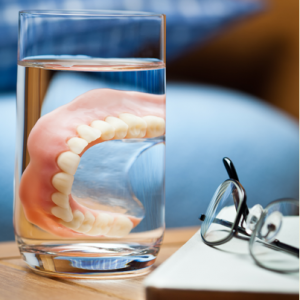 You may have heard the term “edentulous”, a term that describes someone that has no teeth. Incredibly, more than 35 million Americans do not have any teeth. Despite advances in dentistry, this number is expected to grow in the next two decades along with an aging baby boomer generation. Tooth loss commonly results from decay and gum disease.
Up until now, the only option for edentulous patients has been dentures. Their history is a long one. Scientists have found evidence of early dentures, dating back to 700 BC in present-day northern Italy, made of human and animal teeth. Over the years, the materials changed, but the inconvenience of ill-fitting dentures did not.
While dentures are extremely common, most patients find them uncomfortable and awkward. They can make daily tasks most of us take for granted, like talking and eating, difficult.
Presently, dental implants are rapidly becoming the standard of care. The biggest difference in the patient’s experience is that dental implants look and function just like their natural teeth. Most dental implant patients even report not being able to feel a difference! They do not slip or move inside the mouth as dentures are prone to do. Dental implants will generally last longer, as well. This is an important point to consider when comparing costs. While implants are more expensive, they usually last a lifetime. Dentures, on the other hand, can wear down and require replacement.
For patients looking for a more affordable replacement option, with the increased stability of implants, they may want to consider implant-supported dentures. Unlike traditional dentures, which rely on suction, implant-supported dentures are secured by dental implants. Regardless of which route an edentulous patient takes, it is clear that benefits of implants far outweigh those of dentures and will pave the way for a new era in tooth replacement.
If you are interested in exploring dental implants as a replacement for your own dentures, give our office a call to reserve a consultation today!
What To Expect When Having a Tooth Extracted
 One of the most common procedures done in our office is tooth extraction. The removal of teeth can be necessary for a number of reasons, including:
- Joint problems in your jaw
- Shifting teeth
- Too much damage to tooth to be repaired
- Baby teeth that don’t fall out
- 3rd molars (Wisdom Teeth) impacted (wedged between the jaw and another tooth or teeth)
- May be needed to create room for other teeth (such as when you’re getting braces)
Prior to Surgery
In preparation for surgery, we will obtain a full medical and dental history, as well as a list of all medications you take. This includes any vitamins, supplements, or over-the-counter drugs, as well as any medications you are allergic to.
An x-ray is then taken to assess the best way to remove the affected tooth.
You may be required to take antibiotics before or after surgery, depending on the duration of the surgery, or if you have a specific medical condition. Dr. Dr. Colgan will discuss this with you if necessary.
Day of Surgery
At the time of surgery, your oral surgeon will numb the area around the tooth or teeth to be extracted with a local anesthetic, specifically numbing the affected tooth or teeth, your jawbone and the surrounding gums.
During the simple extraction process it is common to feel a lot of pressure. The affected tooth is firmly rocked back and forth so as to loosen it for removal. You should not feel any pain, just pressure. If, for any reason, you feel pain, please notify your oral surgeon immediately so that they can administer more numbing agent.
Surgical Extraction
A surgical extraction is a slightly more complex procedure that occurs when a tooth has not yet broken through the gum line, or has not yet fully grown into the mouth. When a surgical extraction is needed, your oral surgeon makes a small incision into your gum in order to access the affected tooth. From here, the procedure is similar to a simple extraction. Your oral surgeon may stitch the incision site if necessary.
After Oral Surgery
After the extraction you will be asked to bite down on a piece of gauze for 20-30 minutes. This pressure helps to form a blood clot in the extraction site, a crucial part of the healing process. Be careful not to dislodge the clot.
It is common to have a small amount of bleeding 24 hours after surgery. We will provide you with detailed instructions after your procedure, but here are some important things to remember:
Medications/Pain Management
- Take pain medication as prescribed and recommended by your oral surgeon
- Research has shown that taking anti-inflammatory drugs, such as Advil and Motrin (NSAIDs) greatly decrease pain after an extraction
- Using an ice pack on your jaw can reduce swelling. 10 minutes on and 20 minutes off is standard for the first 24 hours. A warm compress can be used if your jaw is sore after the swelling has gone down
Eating/Drinking
- Eat soft and cool foods for the first few days
- Avoid hot foods and alcoholic beverages for the first 24 hours
- Chew food away from the extraction site
- Do not use a straw or spit after surgery. This can cause the blood cut to dislodge, greatly delaying healing
Brushing/Cleaning
- Avoid brushing the area around the extraction site for the first 24 hours
- Avoid using antiseptic and commercial mouth rinses – they can irritate the extraction site
- 24 hours after surgery you can rinse with warm salt water after each meal and before bedtime (1/2 teaspoon in one cup of warm water)
Healing
The extraction site will generally close up in about 2 weeks time, but it can take three to six months for the bone and soft tissue to regrow. Remember, tooth extraction is a common procedure and our caring team has years of experience helping patients through this easy treatment.
FAQs Regarding General Anesthesia for Oral Surgery
Here in our office we perform a variety of treatments including dental implants, facial reconstruction and teeth removal. If you  have recently been diagnosed with a condition that requires any of these types of treatment, you will likely be required to go under general anesthesia.
For some people, impeding anesthesia can induce a bit of anxiety. We completely understand what you are feeling and believe that proper education can help put your fears at ease. The following are some of the most common questions our patients have before “going under”.
have recently been diagnosed with a condition that requires any of these types of treatment, you will likely be required to go under general anesthesia.
For some people, impeding anesthesia can induce a bit of anxiety. We completely understand what you are feeling and believe that proper education can help put your fears at ease. The following are some of the most common questions our patients have before “going under”.
What is exactly is general anesthesia?
General anesthesia is a medically induced loss of consciousness (also called coma) that affects your entire body. This administration of a variety of medications is extremely beneficial for both our patients and our oral surgeons. The side effects include:
The purposes of general anesthesia include:
1. Analgesia (loss of pain)
2. Amnesia (loss of memory)
3. Immobility
4. Unconsciousness
5. Skeletal muscle relaxation.
Is anesthesia safe?
Due to many advances over the past 25 years, the risks of anesthesia are very low. Certain types of illnesses, such as heart disease, high blood pressure and obesity, can increase your anesthesia risks. Still, even very sick patients are routinely brought through major operations safely.
Adverse events are very rare. The specific risks of anesthesia vary with the particular procedure and the health of the patient. You should ask your oral surgeon about any risks that may be associated with your specific condition.
What should I know before I come in?
Before you go to have your procedure completed under general anesthesia, here are a few requirements:
- Have a responsible adult accompany you to drive you home.
- Do not eat or drink anything before 8 hours of surgery.
- Do not drive or operate machinery for 24 hours after surgery.
- Do not wear contact lenses, jewelry, or dentures during the time of your
procedure.
- Do not wear excessive makeup, lipstick, or nail polish on day of surgery.
- Make sure to notify your oral surgeon of any illness, cold, sore throat, or upset stomach.
Are there side effects I should be aware of?
There are a few different side effects of general anesthesia. The most common are nausea, sore throat, sleepiness, and shivering. However, effects may vary greatly with each patient — it all depends on how your body reacts to it. It’s a good idea to consider any prior experience(s) with general anesthesia to get an idea of to know what t expect during your next oral procedure.
Please do not hesitate to contact our office with any remaining questions you have. We are happy to answer them!
Our New Blog
Our blog has recently been set up. Please check back soon!