Dental Implants
in Vero Beach, FL
Dental implants are the most reliable way to replace missing teeth. They feel like natural teeth, function like natural teeth, and last for decades when placed and maintained correctly.

What Is a Dental Implant?
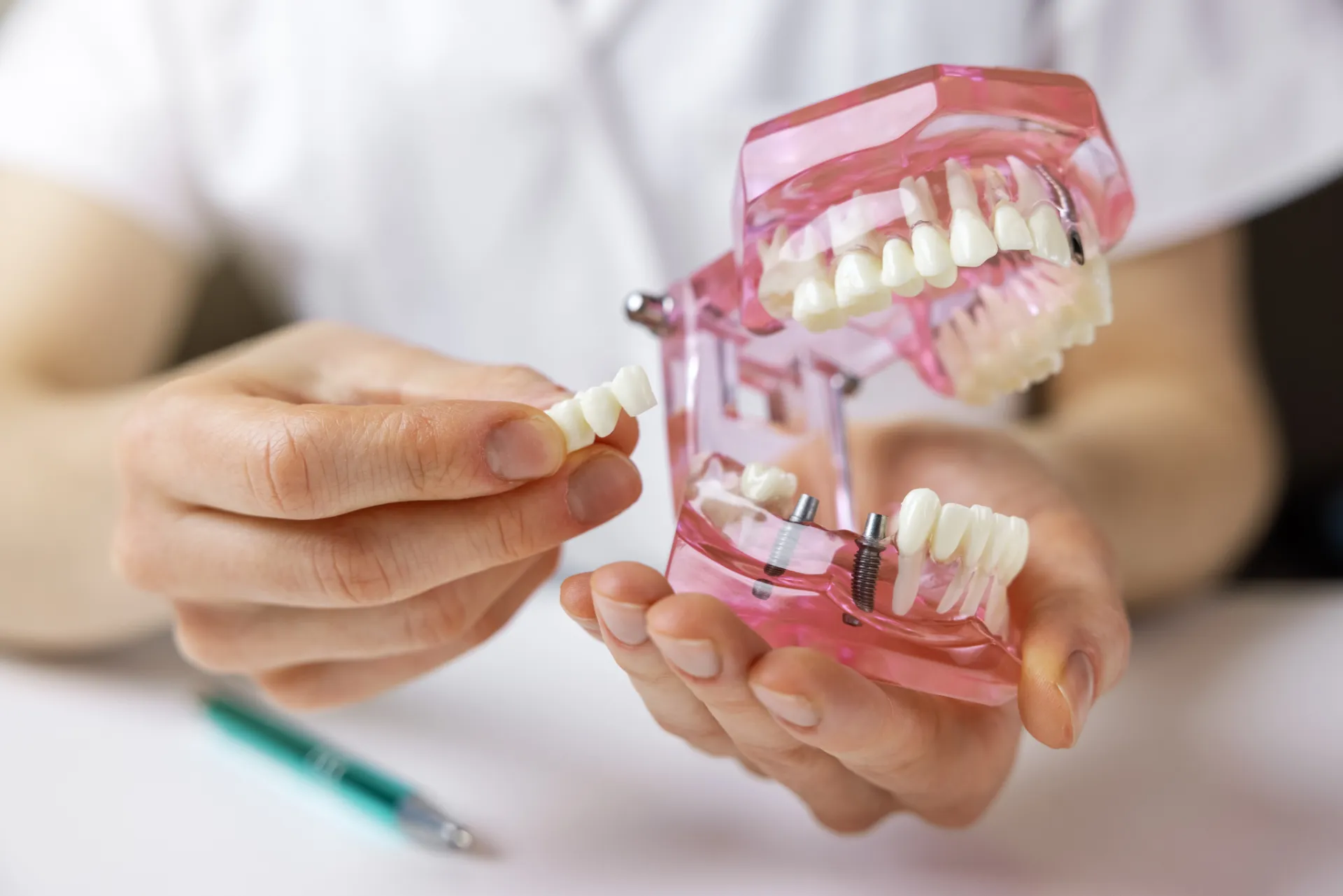
A dental implant is a small titanium post that replaces the root of a missing tooth. It is placed into the jawbone, where it fuses with the bone over several months in aprocess called osseointegration. Once the implant has integrated, an abutment anda custom-made crown (or bridge, or full arch prosthesis) are attached on top.
A complete dental implant has three parts:
Titanium is used because it is the most biocompatible metal known and forms adirect bond with living bone, producing highly predictable, long-lasting results.
Success rates in healthy patients over 10 years.
Implants vs. Bridges vs. Dentures
When you are missing one or more teeth, three main options exist. Each has trade-offs.
Dental Implants
Permanent and fixed
Preserves jawbone
No damage to adjacent teeth
Lowest lifetime cost
Traditional Bridge
Lower up-front cost
Damages adjacent anchor teeth
Bone loss continues beneath bridge
Requires replacement every 10-15 years
Removable Dentures
Lowest initial cost
Unstable for chewing
Accelerates jawbone shrinkage
Can affect taste and speech
Implant Options We Offer
From single tooth replacement to full-mouth restoration, we plan each case based on your anatomy and goals.
Teeth-In-A-Day
For qualifying patients, we can extract failing teeth, place dental implants, and deliver a fixed temporary bridge in a single visit. Patients walk out the same day with a non-removable set of teeth.
Full Arch Restoration
When most or all of the teeth in an arch are missing or failing, full arch restoration replaces them with a fixed bridge supported by four to six implants. This is often called All-on-4 or All-on-X by other practices.
Hybrid Express Platinum
Dr. Colgan’s proprietary full arch protocol. Patients across the country travel to Vero Beach for this refined approach to fixed implant restoration.
Bone Grafting
When the jaw does not have enough bone to support an implant, bone grafting rebuilds the foundation. We use a range of grafting materials and techniques tailored to each case.
Sinus Lift
For upper back teeth, the sinus cavity can sit too close to the planned implant site. A sinus lift gently elevates the sinus membrane and places graft material to create room for the implant.
Ridge Augmentation
When the jaw ridge has narrowed or shrunk after tooth loss, ridge augmentation rebuilds its width and height before implant placement.
The Dental Implant Process
A typical implant case unfolds in stages over several months to ensure the best long-term outcome.
In the majority of cases, a tooth can be extracted and a dental implant placed immediately during the same surgical visit. Dr. Colgan has been performing extraction with immediate implant placement for more than 20 years. This single-surgery approach can minimize treatment time before restoring the implant with a crown and may help decrease the overall cost of treatment.
Evaluating bone volume, nerves, and sinuses using a 3D cone beam CT scan to plan the perfect implant position.
If needed, extraction and bone grafting (socket preservation) are performed to prepare the site for the future implant.
Bone takes time to mature. Most sites are ready for the implant 3-6 months after extraction or grafting.
The implant is placed in our office, typically under IV sedation. The procedure takes 30-60 minutes per implant.
The implant fuses with the bone over 3-6 months. A temporary tooth is used in visible areas during this time.
Your general dentist or prosthodontist places the final crown, bridge, or prosthesis on top of the integrated implant.
Recovery After Surgery
Cost & Financing
Implant costs vary based on the number of implants, grafting needs, and restoration type. We provide a written estimate at consultation and verify your insurance benefits.
Frequently Asked Questions
With proper care, dental implants are designed to last for decades. The implant itself often lasts a lifetime in healthy patients. The crown or bridge on top of the implant may need to be replaced over time (typically 10 to 15 years for a crown), but the implant itself remains in place.
The procedure itself is not painful, especially with IV sedation. Post-operative discomfort is usually milder than what patients expect, typically peaking at 24 to 48 hours and well managed with medication. Most patients return to work within two to four days.
Age alone is not a contraindication. Dr. Colgan regularly places implants in patients in their 70s, 80s, and beyond. What matters is overall health, healing capacity, and bone availability.
Many dental plans cover at least a portion of implant treatment. Coverage varies widely. Our team verifies your benefits before treatment and provides a written estimate.
In most cases, we can build the bone back with grafting, a sinus lift, or ridge augmentation. Very few patients are truly ineligible for implants. Some advanced cases use longer or angled implants that engage available bone in different positions, avoiding the need for major grafting.
A straightforward single implant case takes about four to six months from extraction to final crown. Cases requiring grafting can take six to twelve months. Full arch cases using the Teeth-In-A-Day or Hybrid Express Platinum protocols deliver fixed teeth the same day as surgery, with final restoration completed over the following months.
For qualifying patients, yes. Our Teeth-In-A-Day protocol allows extraction of failing teeth, implant placement, and delivery of a fixed temporary bridge in a single visit.
For most patients, yes. Implants preserve the jawbone, do not damage adjacent teeth, allow normal eating and speaking, and last far longer than bridges or dentures. The up-front cost is higher, but the lifetime cost is usually lower. Some patients still prefer dentures for cost or medical reasons, and we can discuss the trade-offs at consultation.
In healthy, non-smoking patients, dental implant success rates are over 95% over 10 years. Success depends on bone quality, oral hygiene, smoking status, certain medical conditions, and the skill and planning of the surgeon. Dr. Colgan’s case selection and planning approach is designed to maximize that success rate.
Smoking significantly reduces the success rate of implants because it impairs healing and bone integration. We strongly recommend stopping smoking before and during the healing period. If you are unable or unwilling to stop, we will discuss the implications honestly so you can make an informed decision.

Ready to Restore Your Smile?
Dr. Colgan has placed thousands of implants for patients along the Treasure Coast. Schedule your consultation today to begin your journey to a permanent, confident smile.